How Quitting Porn Can Save Your Marriage: What a Therapist Wants You to Know in 2026
Guest post by Clint Davis, LPC, CSAT
As a therapist specializing in trauma, relationships, and sexual addiction, I have spent years working with couples affected by pornography and sexual betrayal. One thing I have learned is that pornography is rarely just about sex.
It often becomes connected to attachment, emotional regulation, secrecy, shame, escape, and intimacy.
That is why asking, “How does pornography affect marriage?” requires us to look beyond the sexual behavior itself. We need to understand what pornography is doing within the individual and within the relationship.
Pornography can create a private sexual world outside the marriage. It can train someone to move toward fantasy instead of relationship, escape instead of emotional regulation, secrecy instead of vulnerability, and consumption instead of mutual intimacy.
Quitting pornography, then, is not simply about stopping a bad habit. It can become the beginning of learning how to be emotionally, relationally, spiritually, and sexually present again.
Table of Contents
- What the Research Actually Says About Porn and Marriage
- How Porn Erodes Intimacy
- Why Quitting Porn Can Improve Your Marriage
- What Recovery Looks Like for Couples
- What Forgiveness Actually Means
- First Steps Toward Recovery
- Recovery Is About More Than Porn
- Connect with Clint Davis
What the Research Actually Says About Porn and Marriage
We should be careful with research on pornography and divorce. Correlation does not automatically mean causation, and marriages are complicated.
Still, the research gives us reasons to take pornography seriously.
A longitudinal study by Samuel Perry and Cyrus Schleifer found that married Americans who began pornography use between survey periods were roughly twice as likely to divorce. Other research has found associations between pornography use and lower sexual satisfaction.
The research matters, but statistics only tell part of the story.
As a clinician, my question is more personal: what is pornography doing in this particular person’s life and marriage?
Is it creating secrecy? Is it changing sexual expectations? Is it replacing intimacy? Is someone using it to escape uncomfortable emotions? Has lying about pornography created a significant attachment injury for their spouse?
Those questions often tell us more about the health of the relationship than frequency alone.
How Porn Erodes Intimacy
One of the most important things I teach about addiction is to look at the function of the behavior, not merely the behavior itself.
In Restoration Therapy, we often examine what we might call a pain cycle. Human beings experience violations of love and trust that can create powerful messages about ourselves and relationships.
We may begin believing things such as:
- “I am not enough.”
- “I am unwanted.”
- “I am powerless.”
- “I cannot trust anyone.”
- “I am alone.”
Those painful messages create emotional responses, and we develop coping behaviors to manage them.
Pornography can become one of those coping behaviors.
Someone feels rejected, lonely, ashamed, stressed, insecure, angry, or sexually frustrated. Pornography provides stimulation and temporary relief.
The pattern becomes:
Pain → painful message → emotional distress → escape → temporary relief → consequences → more pain.
Eventually the thing someone uses to escape pain begins creating more of it.
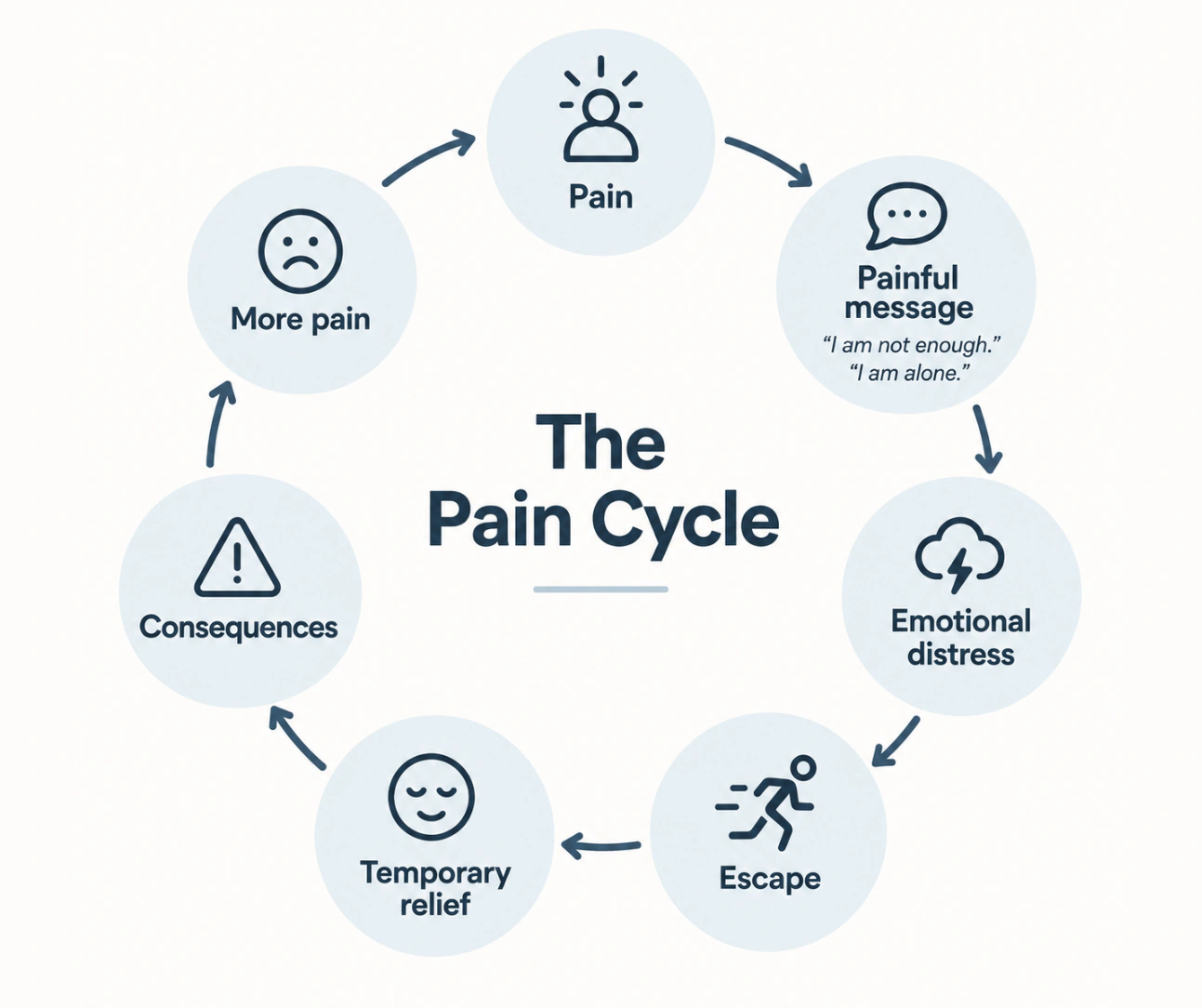
This is one reason porn addiction effects on intimacy can be so destructive. Healthy marriage requires many of the skills pornography allows someone to avoid.
Marriage requires vulnerability. Pornography offers fantasy.
Marriage requires knowing and being known. Pornography allows consumption without relationship.
Marriage requires patience and mutuality. Pornography provides immediate stimulation.
Marriage requires tolerating disappointment and repairing conflict. Pornography can provide an escape from both.
Recovery therefore involves more than stopping pornography. We have to understand the pain underneath the behavior and learn healthier ways of responding to it.
Why Quitting Porn Can Improve Your Marriage
People searching for “quitting porn and relationship improvement” sometimes assume removing pornography will automatically repair their marriage.
Stopping is essential, but stopping is only the beginning.
Meaningful recovery requires replacing destructive patterns with healthier ones.
Secrecy must be replaced by honesty.
Escape must be replaced by emotional regulation.
Isolation must be replaced by connection.
Fantasy must give way to genuine intimacy.
Shame must be replaced by healthy responsibility.
In Restoration Therapy language, we want to recognize our pain cycle and begin practicing a peace cycle. Instead of automatically responding to pain through destructive coping, we learn to identify what we are feeling, challenge the messages we are believing, ground ourselves in truth, and choose actions consistent with who we want to be.
For Christians, I believe this also reflects the invitation of the gospel. Scripture repeatedly calls us out of hiding and into truth. Grace does not mean pretending destructive behavior is harmless. Grace gives us the security to tell the truth, repent, receive forgiveness, and begin walking differently.
What Recovery Looks Like for Couples
When pornography has involved significant secrecy or sexual betrayal, couples frequently make the mistake of trying to repair the relationship before stabilizing the injury.
I describe this using two important ideas: salvage and restoration.
Imagine a house that has just been hit by a storm. Before you start remodeling the kitchen, you stop the water pouring through the roof.
That is salvage. Salvage means stopping the ongoing damage.
In pornography recovery, that may mean stopping pornography use, ending inappropriate relationships or sexual behaviors, establishing accountability, creating technology boundaries, getting professional help, addressing deception, and making the environment safer for the betrayed spouse.
If the damaging behavior is continuing, the couple is not really in restoration yet.
After salvage comes restoration. Restoration means addressing what was damaged.
Sexual betrayal can create significant trauma within a relationship. The betrayed partner may experience intrusive thoughts, hypervigilance, anger, fear, emotional flooding, difficulty sleeping, compulsive questioning, or constantly scanning for additional evidence.
We should not label these responses as bitterness or unforgiveness simply because they make the betraying spouse uncomfortable. The wound needs time and care.
Only after we have begun stopping the damage and tending to the trauma can we responsibly focus on rebuilding trust, intimacy, and reconciliation.
What Forgiveness Actually Means
This distinction is especially important for Christians because forgiveness can sometimes be used to rush the recovery process.
Forgiveness does not mean pretending something did not happen.
Forgiveness does not automatically restore trust.
Forgiveness does not remove consequences or boundaries.
Forgiveness does not require someone to immediately feel safe with the person who hurt them.
And forgiveness should never be used by the betraying spouse as a way of saying, “You are a Christian, so you need to get over this.”
Forgiveness itself has both a salvage and restoration component.
The first part stops the ongoing cycle of vengeance, retaliation, secrecy, and destruction. We surrender our right to personal vengeance and entrust ultimate justice to God. But this does not mean abandoning wisdom, truth, consequences, or boundaries.
The restoration side asks a different question: can this relationship become healthy again?
Reconciliation requires more than forgiveness because reconciliation involves two people.
The betrayed spouse can choose forgiveness, but the betraying spouse must participate in restoration by becoming trustworthy.
Trust is rebuilt through repeated evidence over time: honesty, humility, accountability, empathy, appropriate boundaries, changed behavior, and a willingness to sit with the pain that one’s choices created.
The goal should not be to get back to normal as quickly as possible. Sometimes the old “normal” helped create the conditions for secrecy in the first place.
The goal is to build something healthier.
First Steps Toward Recovery
If you are wondering how to stop watching porn to save your marriage, start with truth and responsibility.
Do not blame your spouse’s appearance, sexual availability, your childhood, stress, loneliness, or problems within the marriage. Those issues may eventually help explain your pain cycle, but explanations cannot become excuses.
A healthy recovery process often includes:
- Stop the pornography and other identified sexual behaviors.
- Tell the truth and end patterns of secrecy.
- Establish meaningful accountability and technology boundaries.
- Seek specialized individual or couples therapy when appropriate.
- Identify the pain cycle underneath the behavior.
- Give the betrayed spouse space to process the trauma without demanding immediate forgiveness or trust.
- Practice healthier responses until honesty, connection, and emotional regulation become a new pattern.
Tools such as Ever Accountable can be valuable because they help reduce secrecy and create accountability around technology. But accountability software is one part of recovery, not the entire solution.
The ultimate goal is not becoming someone who cannot get away with pornography. The goal is becoming someone who no longer wants to live a secret life.
Recovery Is About More Than Porn
Pornography recovery is ultimately about learning what we do with pain.
What do I do when I feel rejected, lonely, ashamed, afraid, stressed, inadequate, or sexually frustrated?
Do I escape? Do I hide? Do I blame?
Or can I recognize what I am feeling, ground myself in truth, reach toward healthy relationships, and choose actions consistent with my values?
For Christians, this is deeply connected to discipleship.
"But if we walk in the light, as he is in the light, we have fellowship with one another." (1 John 1:7, ESV)
That is a beautiful picture of recovery.
Come out of hiding. Tell the truth. Stop the damage. Tend to the wounds. Receive grace. Take responsibility. Learn healthier ways of responding to pain. Then begin the slow work of rebuilding trust and intimacy.
That is more than quitting porn.
That is restoration.

Connect with Clint Davis
Clint Davis, M.S., LPC, CSAT, CCTP, is the founder of Clint Davis Counseling & Integrative Wellness and an Army veteran, ordained minister, author, speaker, and counselor. He specializes in helping individuals and couples heal from trauma, sexual addiction, relational wounds, and other difficult life experiences.
Clint is a Certified Sex Addiction Therapist (CSAT), Certified Clinical Trauma Professional (CCTP), EMDR provider, and trained Restoration Therapist. His approach combines evidence-based psychological care with a biblical worldview to support healing of the mind, body, relationships, and spirit. He is also the author of Building Better Bridges and host of the Asking Why podcast.
Website: ClintDavisCounseling.com
Socials: @ClintDavisCounseling